
Published in Show Beagles Worldwide, Czech Republic, April 2022
There is nothing more unfortunate than watching a newcomer arrive with a high-quality dog and, with the best of intentions, spend two or three hours dragging the poor animal from one place to another before entering the ring exposing him to heat, noise, crowds, and countless dogs. And then, unsurprisingly, seeing the dog enter the ring mentally and physically exhausted, performing poorly, and losing as a result. This is why crate training for dog shows is one of the most misunderstood yet essential tools for any serious handler. This is precisely why I dedicated an episode of my podcast (in Spanish) to this topic. For show a dog understanding how a dog moves is equally important in the ring.
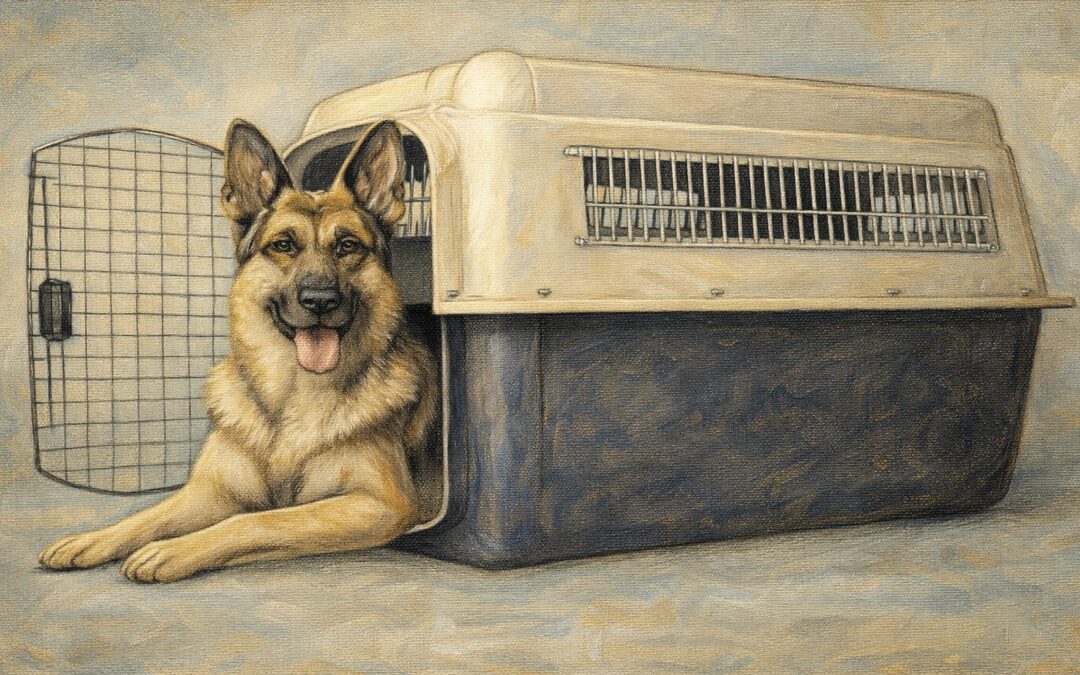
A crate should never be regarded as a prison. On the contrary, it is a place where our dog’s energy can be contained and regulated so that, when it is time to go into the ring, we can channel that energy effectively and allow the dog to look his very best. It is his den his private space and his comfort zone.
There are many qualities a handler must have, as I have mentioned in previous contributions to this publication, but properly managing a dog’s energy is one of the most important.

The best way to explain this is through something I call “The Russian Theory.” Let me elaborate.
It was 2017, and we were in City of Industry, California, when I happened to meet a young Russian handler. She had bravely ventured to the United States to work and learn under the guidance of my friend Jorge Olivera. She had already spent several weeks attending numerous shows throughout California, and because I have always been fascinated by different perspectives, I thought hearing hers would be enriching especially since her cultural and dog-fancier background was very different from mine. I asked her what she thought about the way dogs are prepared and shown in the U.S., and what her impressions were of our customs and methods.
Her answer gave me much to reflect on. She told me that the European perception of American handlers is shaped by YouTube videos usually from glamorous events like Westminster and that she originally believed some special, sophisticated technique was used here to achieve that level of glamour and perfection. But what she actually observed was quite different. I quote her almost literally:
“I see that what you do is leave the dog in a crate, then take him out, bring him to the ring, and he arrives eager to express himself.”
That single sentence perfectly captures the value of having a dog well-habituated to resting in the crate. We should think of the crate as an energy manager—a place where the dog can disconnect from the environment and arrive at the ring physically, and especially mentally, fresh.
Training a Dog to Relax in the Crate
It must be a gradual process. No matter the puppy’s age, we should begin with short periods inside the crate say, an hour. If he can be accompanied by a sibling or even a stuffed toy, it helps reduce anxiety. Over the course of days and weeks, we can slowly increase the time. We should also leave the crate open during the day so the dog can choose to go in on his own, which happens far more often than one might expect.
Using the same bed for several days helps, as the familiar scent encourages the dog to return. Feeding inside the crate is also a great idea; most puppies have a voracious appetite, and this creates a positive association.
Getting used to the crate bring practical advantages as well: many hotels require dogs to be crated, and if the dog ever needs to travel by air, being comfortable in a crate makes the process infinitely easier.
Advantages for the dog and for the human
So far, I’ve talked about the benefits for the dog, but the crate also brings advantages to us. Being able to leave our dog safely resting allows us to socialize, make friends, and observe the judging of our breed—and others—in detail, which is essential for continuous learning. Crate-trained dogs also make it possible to travel with more than one dog, or even to share long trips with a travel companion, reducing costs. If our dog had to always remain loose, none of this would be feasible.
The crate is a safe place, and we must see it that way.
Why Crate Training for Dog Shows Matters
Advantages, advantages, advantages. The crate is a tool that, when used correctly, allows us to enjoy the sport more whether we win or lose. A well crate-trained dog will always have an advantage in the show ring. Im sure all this concepts will help you to proper stacking complements a dog’s performance in the ring.
I would love to hear from you at www.dogsconnection.net. Let me know if you have had any challenges crate-training your dog, or what your experiences have been.
Until next time: “The best is yet to come.”