
The Journey to Geneva
This World Dog Show Geneva review begins with an unexpected journey. My long-awaited journey did not begin as smoothly as I had hoped. Shortly after learning that my flight to London, where I would connect to Geneva, was delayed by three hours due to a lightning strike before arriving in my city, we were informed that the flight had been completely canceled.
Through the airline’s app, I noticed I had already been reassigned to the same flight the following day, which meant missing the first day of the event, the Grand Prix. Without hesitation, I joined the long line to find an alternative. I eventually departed five hours later than planned, heading to Newark, New Jersey.
Upon landing, as soon as I regained signal and opened Facebook, I was met with exciting news. The Mexican Kennel Club (FCM) had secured the hosting rights for the World Dog Show 2028. I couldn’t stop smiling. Just a few posts later, I learned that my fellow judge, Gerardo Bernard, had been selected for the judging panel at the Westminster Kennel Club Dog Show. I immediately reached out to him. “Today is a day of fantastic news.”
After spending 11 hours wandering Newark Airport, I finally boarded a 9-hour direct flight to Geneva, arriving just two hours before the show began. Exhausted but determined, I checked into my hotel, showered, and reached the venue only 30 minutes after judging had started. The show was already in motion.
Event Format and Participation
Traditionally, European World Dog Shows allow each dog to compete only once, with groups distributed over four days. Recently, however, organizers have introduced an additional opening day where all dogs can participate. This day, featuring CACIB competition, was called the Grand Prix.
Additionally, numerous breed specialties were organized, allowing some dogs to compete up to three times. This format proved highly effective, with an impressive total of 13,406 entries.
The Venue and Organization
Entering the venue was seamless. I located the press room, picked up my accreditation badge, and most importantly, found coffee.
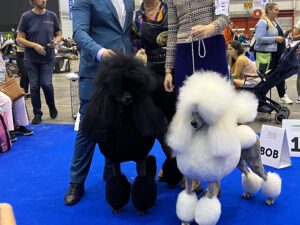
The event featured 80 rings inside a single building, with the main ring of honor located in one corner. Each ring was covered with a thin blue carpet (“moqueta” in Spain), but notably lacked physical barriers—very much in the European style.
Seating was minimal: a small wooden bench per ring, accommodating only four or five people. A simple wooden post displayed the judge’s name and assignments, printed in surprisingly small text.
Given Switzerland’s reputation for wealth and precision, one might have expected more infrastructure. Still, the essence of the event, the global canine celebration, remained intact.
One major advantage was the proximity of accommodations. The Hilton Geneva Hotel and Conference Centre housed the judges, while two Ibis Genève Airport hotels sat just steps from the entrance.
Temperatures reached 36°C (96°F) by mid-morning, and the air conditioning struggled to keep up. Both dogs and handlers felt the heat.
A Fully Digital World Dog Show
One of the most remarkable aspects was the complete digitalization of the event.
There were no printed catalogs. Instead, all information was accessible via QR code on the accreditation badge. Judging schedules and catalogs were available in ten languages, functioning flawlessly across devices.
Results were updated in real time, as judges’ ring stewards entered data directly into iPads connected via event-wide Wi-Fi—free for all attendees.
A thoughtful detail: results included gender symbols before each dog’s name and a national flag indicating the country of residence.
Even more impressive, all exhibitors arrived with their numbers printed at home, having received them via email two weeks prior.
International Ring Stewards
As seen previously in the Czech World Dog Show, organizers opened applications for international ring stewards. This proved to be an excellent decision, especially in a multilingual environment where English is often the common ground.
I had the pleasure of speaking with a Spanish-French steward who worked in Dr. Payró’s ring. She shared that they were provided with quality accommodations, meals, and a modest financial compensation.
Their professionalism and enthusiasm were evident; they played a direct role in the event’s success.
The Ring of Honor
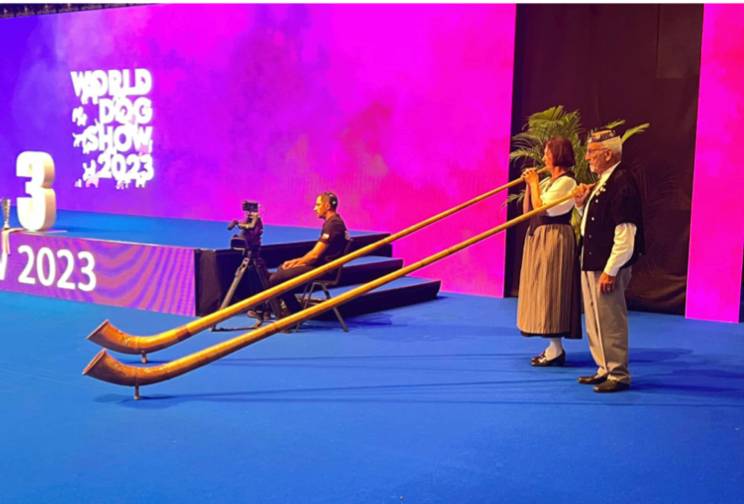
The ring of honor was hosted by Linda Volarikova, who delivered the English commentary with elegance and confidence. Having seen her in previous World Dog Shows in Brno, Madrid, and São Paulo, I can say she performs this role exceptionally well.
The French version was handled by Joe Bellyss Borges, bringing charm and energy.
Production quality was excellent: music, lighting, screens, and national flags created a polished and engaging atmosphere.

Exhibitors and Global Competition
Exhibitors came from all over the world. Compared to Brno and Madrid, there was a noticeable increase in Asian participation. Their dogs were presented in outstanding coat condition and grooming, achieving significant wins. Most of the dogs move very well.
Russian exhibitors absent in Madrid returned strongly, showcasing exceptional handling skills and top-quality dogs across many breeds.
Even Ukrainian exhibitors were present, winning several breeds, particularly in Groups 3 and 9.
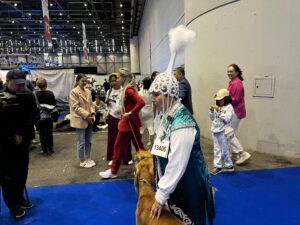
One of the most fascinating stories came from Kazakhstan. Their delegation presented the Kazakh Tazy, a breed not yet recognized by the Fédération Cynologique Internationale. Their dogs had traveled over 8,000 kilometers by road to attend the show.
Their traditional attire and cultural pride added a unique and memorable dimension to the event.
Regulations and Controversies
Before the show, there had been considerable concern regarding restrictions on certain collars and grooming products. Given the importance and complexity of this topic, it deserves a dedicated article in this series.
Best in Show Results
Around 6:00 PM, the show reached its conclusion. The Swiss judge, Laurent Pichard, selected the Best in Show winners:
- 1st Place: Portuguese Water Dog (Norway-breed, owned and handled by Portuguese exhibitors)
- 2nd Place: English Setter (American-bred, handled by a Russian handler)
- 3rd Place: Affenpinscher (Canadian-bred, handled by a Spanish exhibitor based in Croatia)
Looking Ahead to Future World Dog Show
The Fédération Cynologique Internationale flag was officially handed to the Croatian delegation, marking the next World Dog Show.
As the flag was lowered, I couldn’t help but think of the moment when Mexico will receive it. Four years may seem far away, but time flies.
See you in Croatia.
The best is yet to come.