
Published in September 2025 at Dogs News EC (Ecuador)
Hello Thomas, thank you for taking the time to have this interview with us. How are you?
Hello Guillermo, I’m great, thank you. I finally recovered from this very busy week that was the World Dog Show.
I saw you frequently during the WDS, even showing dogs. For our American audience who may not know you well, please tell us: who is Thomas Wastiaux, where is he from, and what has been his past and current role in the sport?
I was born in Belgium, but I have lived in several countries. For the past 15 years I’ve been living in Slovakia, in Central Europe, about an hour from Vienna.
I began attending dog shows almost 40 years ago as a Junior Handler, and by showing my parents’ dogs. This “virus,” like for many others, caught me immediately, and I never left the sport. I worked as a professional handler for nearly 20 years in Europe, although that chapter is now behind me. Together with my wife also a former handler we now show our own dogs and breed Berger Picards under the kennel name Freedom Field.
Besides breeding, I have been judging Junior Handling competitions for several years, and this is my sole focus within the sport. I’m not looking to become a breed judge. I have had the opportunity to judge in many countries such as Norway, Croatia, Hungary, Estonia, Lithuania, Russia, and Finland.
I know you were selected to judge the Junior Handlers at the WDS in Helsinki. Tell us about that. How did the process begin did you receive an email, a call? Were you surprised?
It was a huge surprise. I was having my morning coffee when I received a message from my friend Hilde Fredrikson asking if I would be interested in judging the final at the WDS. My answer was, of course, YES! (laughs). I even thought about opening a bottle of champagne, but it was a bit too early in the day.
I later learned that the Finnish Youth Committee had compiled a list of candidates, and they unanimously agreed that I would be the ideal person for the job. They were certain I would truly enjoy the experience and for them, that was the most important part.
I noticed you changed outfits before judging in the honor ring. What motivated that decision?
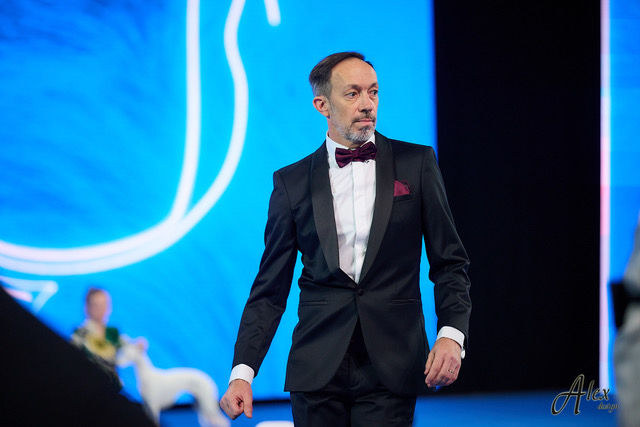
That’s a good question. I like to dress appropriately for the task or responsibility I’m given. Wearing a suit and tie for the qualification judging was, of course, expected. But for the final, I felt it was important to “level up” my appearance.
How often will I have the opportunity to judge such a prestigious final? It’s an exciting moment not only for the juniors but also for the judge. I wanted to feel confident, so I wore a tuxedo also as a gesture of respect toward all the juniors who came to represent their countries and those who qualified.
What difference, if any, did you find between the performance you expected and what you saw in the ring?
There is no doubt that my podium winners delivered exactly what I expect from Junior Handlers especially my first place winner. I have no hesitation in saying that from the very first steps she took in the ring, she moved with her dog exactly as I hoped, and she never failed to impress me.
I look for juniors who truly understand what they are doing. It may sound simple, but it rarely is. I want to see them stack the dog in a way that highlights its qualities and minimizes its faults. I also expect efficient movement not merely executing figures around the ring. A final test was the free stack, which reveals whether the junior genuinely understands the dog and the task.
I had a very strong group of eight juniors who could have easily made the podium. The overall quality of the 36 participating countries was exceptionally high, and I truly enjoyed judging them. It reassured me that our sport is moving in the right direction.
What was the most challenging part of your job as a judge? Was there any particular detail that helped you make your decisions?
The greatest challenge is that you are evaluating children, not dogs, so emotions naturally run higher. You can also sense when some juniors are stressed, and I see it as my role to help them feel as comfortable as possible so they can perform at their best. I’ve been in their position, so I know how difficult it can be.
I’m not looking for mistakes; I’m looking for improvement. That makes the selection more difficult. I was supposed to choose 10 finalists, but the qualifiers from the three days were so good that I asked for permission to select 15. They deserved to be in the spotlight.
Do you think the FCI and the Kennel Clubs in general are doing enough to support and encourage the next generation?
I cannot speak for the KC, as I am not involved in it, but from what I see at Crufts and other events with so many youth activities I believe the KC Youth Program is well managed and performing strongly. We should collaborate with them and learn from their success.
Regarding the FCI, I will be honest: no, not enough is being done. Whatever progress exists comes from national Kennel Clubs, and mainly from individuals. Nordic and Baltic countries have outstanding Youth Kennel Clubs.
The FCI Youth program, created years ago, is inactive, and nothing is happening with it. It is very disappointing, and I do not see any intention from the FCI leadership to revive it.
What is your opinion about the limitations in some countries regarding the type of collar a handler can use?
Many regulations arise from a lack of knowledge. They are often made by people who rarely show, or do not even own, show dogs. The collar issue is just one example. We now live in a world where defending ourselves or explaining our sport often leads to being attacked.
Something caught my attention: in Europe, just like in the U.S., around 80% of Junior Handlers are girls. Why do you think this happens?
This has always been the case, even when I started 40 years ago. I don’t think it’s a trend it’s human nature. Girls tend to mature earlier, and boys may feel less comfortable entering a ring and showing dogs. Perhaps shyness plays a role.
However, among adults the number of men in the ring rises significantly.
And the boys who are present in Junior Handling are usually extremely talented.
What is your opinion on the practice of switching dogs during Junior Handling competitions?
I’m not a big fan unless there is enough time for juniors to get used to the dogs, and as long as the final evaluation does not rely solely on the switch.
I used the exercise at the WDS, but I only asked for a free stand and an up-and-down simple and not too demanding. It can be challenging for juniors to adapt to a new dog in just a few minutes, but from a judge’s perspective, it is a useful tool to see how they handle a new challenge.
Do you think the overall handling level is better now than 10 years ago?
In Junior Handling, absolutely yes. The improvement is significant. I believe this is because many past events were organized by competent Kennel Clubs and Youth Programs that invited judges who truly care about Junior Handling, not those focused solely on “Golden Rules.”
Many of us instruct juniors to handle their dogs as they would in a breed ring—nothing more. You will never see me asking for reverse triangles or strange patterns that force the junior to jump behind the dog.
This approach has given juniors a clearer path to develop real handling skills, and the results are visible.
 What is your prediction: in 10 years, will there still be people making a living as professional handlers in Europe?
Will we even have dog shows in 10 years in Europe? I’m sorry to respond with a question, but at the current pace, and without strong action, it may become very difficult for some countries to host shows at all.
Europe does not have professional handlers in the same sense as the USA, so I prefer to speak broadly. I hope the FCI will take decisive action to protect and preserve our sport.
To end with a complex question: if you had a magic wand, what would you change about the current situation in our sport?
First, I would use it to go back in time around 25 years when the legislation banning tail docking and ear cropping appeared in Germany. That moment was the beginning of a decline in our dog world, and nothing was done to counter it.
Then, I would hire a great PR company to promote our sport and responsible breeding and a renowned lawyer to defend our rights.
Thanks again, has been a pleasure.