
There are concepts that, even in the mind of someone with a memory as deficient as mine, remain engraved forever. This is the case with an idea I heard years ago during a seminar on movement that I found particularly fascinating:
When studying canine movement, the dog must be understood as a living biomechanical system. Every stride, every extension, every push of propulsion is governed by the interaction of bones, joints, ligaments, and muscles. Yet surprisingly, while most canine anatomy books label over 300 bones, they often fail to clearly identify the joints that truly determine movement efficiency.
The Problem With How We Talk About Movement
Published originally in October 2022 in the printed magazine Show Beagles Worldwide. Reproduced here with permission.
In conversations among exhibitors and judges, it is very common to hear phrases such as:
-
“That dog is too straight in front.”
-
“That dog lacks rear angulation.”
Although these expressions are widely used, they are technically imprecise and tell us very little from an anatomical standpoint.
To speak correctly about movement, we must first understand what joints are and how they function. Structure directly impacts how a dog moves in the ring.
What Is a Joint?
The branch of medicine that studies joints is called arthrology, a subject I studied during my training as a veterinary medical doctor within the anatomy curriculum. I was fortunate to have an excellent professor an affable man with a very distinctive mustache and a good repertoire of jokes that he used to keep us awake during those early 7 a.m. classes. But as often happens, I am drifting off topic, let us return to the matter at hand.
A joint is defined as the union of two rigid structures that allows relative movement between them. In the dog, these rigid structures are bones, which move through the coordinated action of muscles, tendons, and ligaments.
There are several ways to classify joints. For the purposes of this article, it is sufficient to mention that there are:
-
Simple joints, formed by two bones
-
Compound joints, involving three or more bones
Joints of the Forelimb
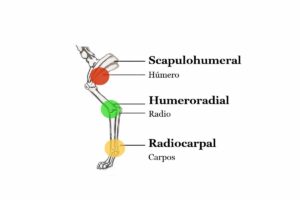
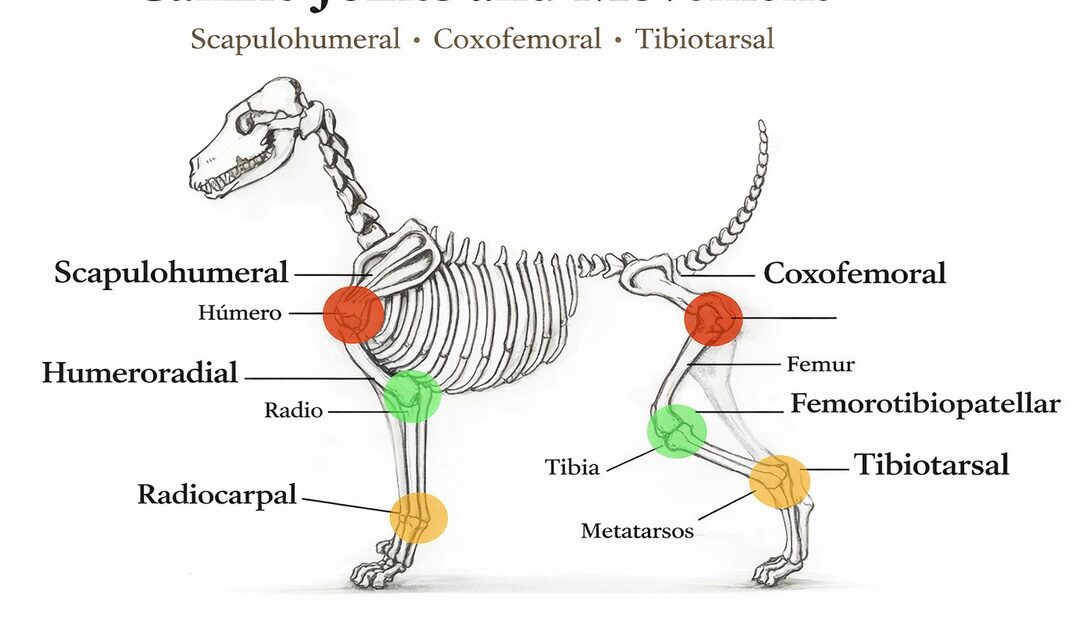
The joints that influence movement are primarily those of the limbs. Their nomenclature is straightforward: they are named by combining the upper bone with the lower bone.
In the forelimb, one of the most important joints is the scapulohumeral joint, formed by the scapula and the humerus. This joint is responsible for reach that is, how much ground the dog covers with each stride which depends on its degree of angulation.
Below it is the humeroradial joint, formed by the humerus and the radius, commonly known as the elbow.
Further down is the radiocarpal joint, formed by the union of the radius and the carpus.
The correct structure of these joints determines, among other things, whether the dog can produce the proper front movement typical of its breed. In most breeds, this movement is straight, following the trajectory of the radius, with well-known exceptions such as the Welsh Corgi Cardigan when viewed from the front, or the Basenji when observed in profile.
Forelimb joints of the dog showing scapulohumeral, humeroradial and radiocarpal articulations
In the hindquarter, the first joint to consider is the coxofemoral joint, formed by the femur and the acetabulum of the pelvis. This is undoubtedly one of the most important joints in the dog, as it is the strongest and most robust; it is where propulsion is generated. The amount of ground a dog covers with each stride depends greatly on its angulation.
Next is the femorotibiopatellar joint, formed by the distal end of the femur, the patella, and the tibia, commonly known as the stifle. This is a clear example of a compound joint.
Finally, we find the tibiotarsal joint, formed by the distal end of the tibia and the bones of the tarsus, also known as the hock. Its importance lies in the fact that, in all breeds, its firmness directly influences how efficiently the force generated in the hip is transmitted. A weak structure in this joint results in what is commonly referred to as cow hocks.
Joints of the Hind Limb
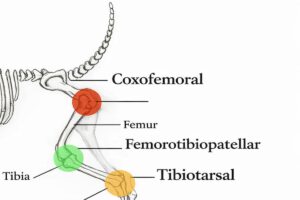
In the hindquarter, the first joint to consider is the coxofemoral joint, formed by the femur and the acetabulum of the pelvis. This is undoubtedly one of the most important joints in the dog, as it is the strongest and most robust; it is where propulsion is generated. The amount of ground a dog covers with each stride depends greatly on its angulation.
Next is the femorotibiopatellar joint, formed by the distal end of the femur, the patella, and the tibia—commonly known as the stifle. This is a clear example of a compound joint.
Finally, we find the tibiotarsal joint, formed by the distal end of the tibia and the bones of the tarsus, also known as the hock. Its importance lies in the fact that, in all breeds, its firmness directly influences how efficiently the force generated in the hip is transmitted. A weak structure in this joint results in what is
In the hindquarter, the first joint to consider is the coxofemoral joint, formed by the femur and the acetabulum of the pelvis. This is undoubtedly one of the most important joints in the dog, as it is the strongest and most robust; it is where propulsion is generated. The amount of ground a dog covers with each stride depends greatly on its angulation.
Next is the femorotibiopatellar joint, formed by the distal end of the femur, the patella, and the tibia—commonly known as the stifle. This is a clear example of a compound joint.
Finally, we find the tibiotarsal joint, formed by the distal end of the tibia and the bones of the tarsus, also known as the hock. Its importance lies in the fact that, in all breeds, its firmness directly influences how efficiently the force generated in the hip is transmitted. A weak structure in this joint results in what is.
Why Terminology Matters in Judging
In the show ring, imprecise language leads to imprecise evaluation. Saying a dog is “straight in front” without understanding whether the limitation originates in the scapulohumeral angle or the humeroradial articulation reduces judging to opinion rather than anatomical assessment.
Correct terminology refines perception. Refined perception improves evaluation. And improved evaluation elevates the sport.
Final Reflection
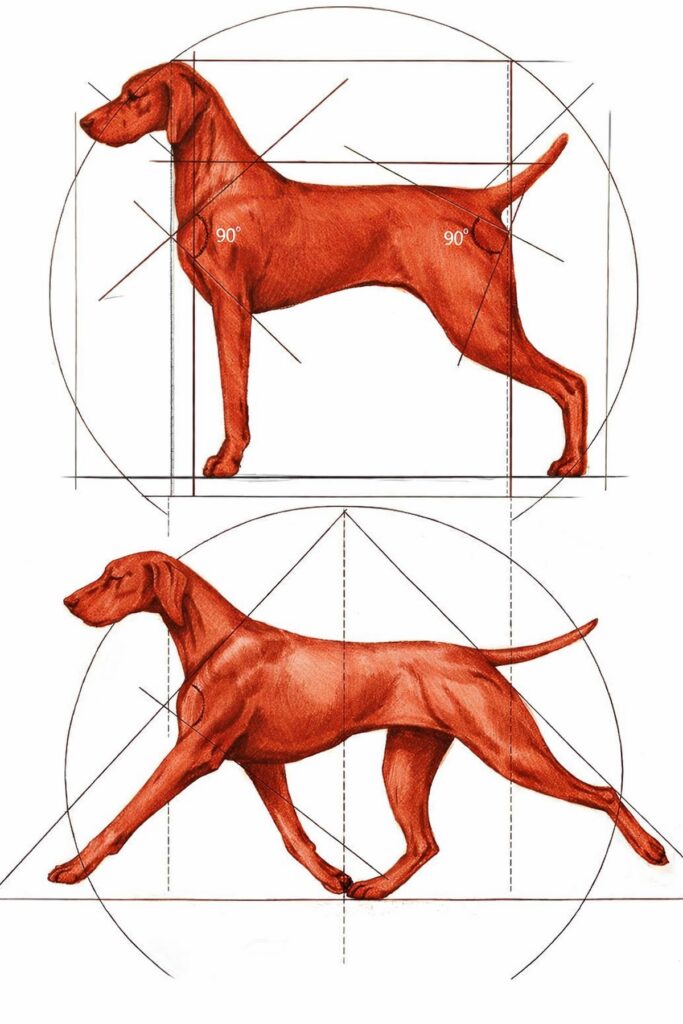
Having said all this, I hope that the next time you find yourself in a conversation involving joints or movement, you will be able to express yourself with greater precision. Clear terminology optimizes communication and we must not forget that all knowledge begins with communication as explained in our in-depth guide on understanding movement in show dogs, joint angulation directly determines efficiency and balance in motion. Please don’t forget that proper presentation in the ring depends on both structure and handling
“The best is yet to come.”