
Published in September 2025 by Best in Show USA Magazine
First impressions.
It took me 28 years to return to Finland. I remember it like it was yesterday, that excitement of my first European World Cup. Sponsored by Pedigree, we placed those two English Mastiffs in the hands of KLM Airlines and arrived in Helsinki, exhausted but still hopeful. Those who know me know that I don’t like to talk about my successes right away, but coming to a World Dog Show in Finland from Mexico and winning the breed and the opposite sex with an entry of 72 Mastiffs is something I can’t help but share with you today.
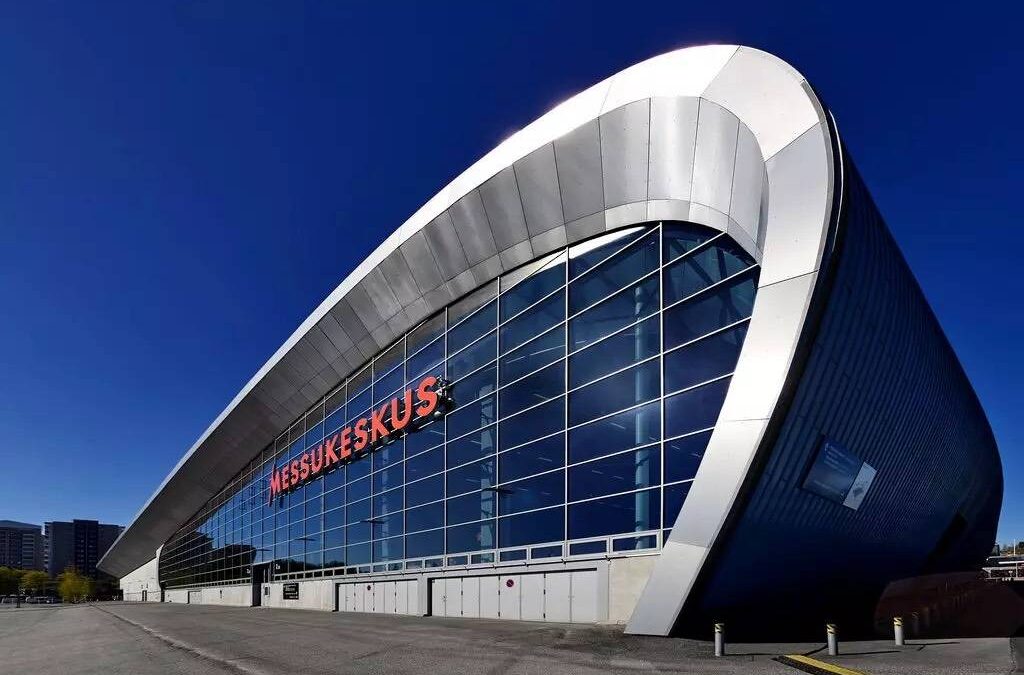
But let’s return to the present, August 2025. Shortly after visiting and checking in at the press room, I went downstairs to find a first-class venue. Cafes and restaurants of various types, even one with a buffet, began to show me the excellence of the place, which I needed to explore to find my bearings and navigate the event as efficiently as possible.
The big question hanging in the air was how it was possible that this World Championship had been reduced to three days instead of the usual four. It seemed impossible with the number of dogs entered, and the judges were also instructed to write critiques of the four dogs placed in each class. We were going to be there until 10 p.m. How were they going to do it? My doubt was resolved when I visited the second floor and saw that the World Championship was going to be held in an exorbitant 96 rings. I understood everything.
Just like the World Championship two years ago in Geneva, this time the famous FCI General Assembly had also held. On that occasion, the news was that our beloved Mexico had been designated to host the World Dog Show in 2028. This time, there was also a bombshell of news on social media; the proposal submitted to the FCI to allow dogs with cosmetic surgery to be shown in the Americas spread like wildfire. There was some hope among all the Latin American executives I was able to speak with, although their opinions were very diverse and not all of them were optimistic about the proposal’s chance of success. Anyway, let’s see what happens.
The first day served as a preamble, as there were specialty shows in various breeds. I approached the Beagle ring, which was being judged by Norwegian Svein Erik Bjornes. I found a seat next to my friends and experts on the breed, Lesley Hiltz and Penny Tretrille. We were seated right behind the table where the dogs were being examined. To my surprise, Mr. Bjornes was literally dictating his critique of each of the dogs placed on the table. Interestingly, he had a radio headset transmitter with a headset and microphone, which he used to immediately dictate all his impressions of each dog to a judge’s secretary, who with nimble fingers captured all the information on a laptop. Our proximity to the table allowed us to perfectly hear everything he said. It was a fascinating sight to see how the information flowed so organically. Lesley and I couldn’t resist the urge to approach and congratulate Mr. Bjorenes. In addition to his smiling and courteous manner with the exhibitors, he demonstrated a very high level of concentration throughout his judging, and we largely agreed with his decisions. I have to say, his friendliness is one of my best memories of this trip.
One thing I found a little strange was that nowhere was it announced that the group competition would be held that day, or at least I never found out, since that day’s event was governed by the local breed clubs. I was surprised to walk around exploring other rings and see competition between various breeds in what could be considered an incomplete group, and even some unusual fusions, such as the Yorkie, whhich belongs to the Terrier group, competing with breeds from the Toy group.
The World Dog Show.
Early Friday, the Terrier, Toy, and Hound groups flooded the rings prodigiously, trying to become world champions. I saw quality in virtually every breed. Of those in the group, I remember a Westie, a magnificent substance wrapped in high-quality grooming that made him look like a piece of white porcelain, moving with solidity and determination. Along with the Swiss Afghan Hound, who won his group, and the Fila Brasileiro, which I’ll discuss later, they were probably the two dogs that impressed me the most. One of the things I noticed, unlike the other European World Shows I’ve had the opportunity to attend, is that Finland’s geographical location really affected the influx of dogs from Eastern and Southern European countries. The fact that ferry access from various locations made attending the event both complicated and expensive. These are probably the reasons why, in my experience, this was the only World Show I’ve attended that featured a lower percentage of foreigners than usual.
The hostility toward Russian exhibitors and breeders was evident. There were only a few of them, and as I’ve always said and will continue to say, Russia is the leading European power in the breeding of many breeds. Asking around, I learned that they are not legally allowed to enter Finland with their Russian passports, nor are tourist visas available for them. They can only enter Finnish territory with a valid work permit issued by another European Union country. It’s truly a shame that this show has deprived all these dogs and talented people and approximately three thousand dogs, for political reasons beyond its control. Anyway, we’ll see them in Italy. The Asian presence, let’s say, was the usual, very strong in breeds such as Poodles, Coton, Bichon, and Pomeranians. The North American presence was also quite discreet, which I’ll talk about a little later.
The ring of honor, magnificence hand in hand with technology.
After the opening ceremony, which I honestly don’t even remember how it went, the first competition I witnessed was the brace competition for the three groups that day. The ring layout was on the left side stood the dog entrance, in the center of the ring were the four podiums where the four winning dogs would stand, and in the background, and without a doubt, this was the largest and most unique display of resources and technology. I’m referring to this screen, whose dimensions practically stretched from one side of the ring to the other and its height was quite considerable: we never seen anything like it. To the right and in the background was a small station where the masters of ceremonies performed their duties. Far to the right and away from the stage, a small musical band of four or maybe five members gave a discreet yet timely performance, I loved that. There were two screens above where the images captured by the cameras were projected; I imagine they were the same images that could be seen in the live broadcast online. But the big moment came when Frode Jevne was announced as the judge for the braces. Suddenly, and to everyone’s surprise, the enormous screen I mentioned magically opened in half. A spotlight focused on the judge’s silhouette, which remained static for a few seconds before moving toward the center of the ring. An epic moment!
But that wasn’t the only innovation; the awarding process was also a technological feat worthy of mention. The judge, having prejudged all the breed winners backstage, walked along the line and preselected about 10 dogs, which he then moved. As soon as he decided on his four winners, the judge’s secretary diligently approached him, iPad in hand, to take note of the chosen ones. The judge first stood on the podium, holding the corresponding rosettes. The moment the dog’s breed was announced over the PA system, immediately and I mean so quickly that before the dog even reached the podium its name, its owner’s name, and its country of origin with its corresponding flag appeared on the right screen. You can’t be more efficient and keep the public better informed than that.
The Uncrowned Champion
But the most exciting part was reserved for Saturday. Karl-Erik Johansson was designated to judge group number two, the working group. He diligently made his cut, and third in line was a dark fawn Fila Brasileiro. He sent it up and down, thus making history, without winning the group. This Brazilian-bred dog, now settled in Colombia, lived up to the breed standard with the way he moved. His handler, Jimmy Montoya, showing off his skill, took his first steps walking, holding the dog directly by the collar. Then he accelerated, and the dog began to trot calmly, without fuss, positioning his tail and head in such an elegant manner and finding that very molosser balance, claiming the perfect balance between a Bloodhound and a Mastiff truly a spectacle. He won second in his group, but that was really the least of it. Within hours of posting the video of his up and down, I began receiving messages from judges and exhibitors from around the world asking me the whys and wherefores of the way this elegant molosser had performed. The easiest way to explain it was to cut out the part of the standard that describes this breed’s very peculiar way of moving. Hours later, the dog went viral. The video reached nearly 1,500 reactions on my feed alone and was shared more than 150 times. The owner and breeder contacted me to thank me for the video. Even the president of the FCI himself dedicated a post to it, alluding to both the excellent presentation and the dog’s appearance. A true uncrowned champion. One of those dogs that you never forget!
Mexican-American Representatives
From Mexico, our main protagonists were the Xolos, although this time our representation was lower in numbers but not in results. On the first day, the famous El Andariego (Suedan), better known as Antonio, made a killing among the miniatures. Not content with winning the breed, he emerged as the group winner on the day of the specialized show. On the day of the world event, he had no problem winning the breed again, a source of pride for Mexico, and with extra merit considering he’s a miniature. A dog that undoubtedly has it all and combines his morpology and type with a fabulous attitude in the ring. Antonio is bred by Giovanna Suedan, owned by Giovanna Suedan, Marcelo Rodriguez, and Orlando Cano, and masterfully handled by Rodolfo Farias. Congratulations to everyone; we were very well represented.
And in an overwhelming manner the Xolo Standard Masterrock Calaco who is owned by Silvia Tojo, Miguel Alonso, Juan Carlos Luna and Maria Macedo and bred by Silvia and Miguel, managed to win the breed without any problem under the judging of my good friend Manuel Queijeiro. At night supported by the talent of the American Dylan Kipp who has been making a sensational duo with him in other scenarios he entertained himself winning the group and not satisfied with that on Sunday under the judgment of the Finn Harri Lehkonen after looking spectacular he won the reserve of the most important ribbon, yes the reserve of BIS! thus becoming the only Mexican dog winner of such a high honor in this century. Calaco not only represents his breed but also runs through his veins a colossal pre-Hispanic legacy, a thousand-year-old history transformed into a true show dog. A dog came to triumph, thrilling us all, and with his extraordinary movement vindicating the Mexican breed par excellence. My congratulations to his breeders and owners, and of course to Dylan, who contributed his part to Calaco’s soaring success in the FCI’s most important ring.
There were also some fellow Yorkies who were quite successful. On the first day, both the junior male and female stood out in their categories when judged by Douglas Johnson from USA. On the day of the World Championships, under the judging of Jussi Liimatainen, both young dogs performed with great quality and placed within their classes, but the best was waiting for the end. Sijevale Waikiki returned to Mexico as none other than World Champion. She is bred by Elena Mishura. The names of the juniors, respectively, are Reaks Valentino and Reaks Mia Shiranui, both bred in Mexico by Rene Alva and Efren Keymolen, all of whom are expertly handled Efren. There’s nothing like seeing dogs born in Mexico triumph in venues not only so far away, with almost 80 Yorkies entered, but also so prestigious. It surely won’t be the last time. My sincere congratulations to these Mexican breeders.
The Juniors
Something I personally hadn’t had the opportunity to experience was the participation of Mexican juniors in European world shows. On this occasion, both Vanessa Chavez and Guillermo Cadena, better known as Memito, made their appearance. I must say that regardless of the results, it was very gratifying to see these two individuals fulfill their dream of being in a world show. We’re all a bit tired of hearing here and there that dog breeding as a sport is dying, and they came to Helsinki to prove the opposite. I hope they’re just the first of many. The families’ efforts to undertake this ambitious journey are worthy of applause. Like good Mexicans, they reinvented themselves and despite all the difficulties, succeeded. From me, I offer them all my recognition and support.
The Judges
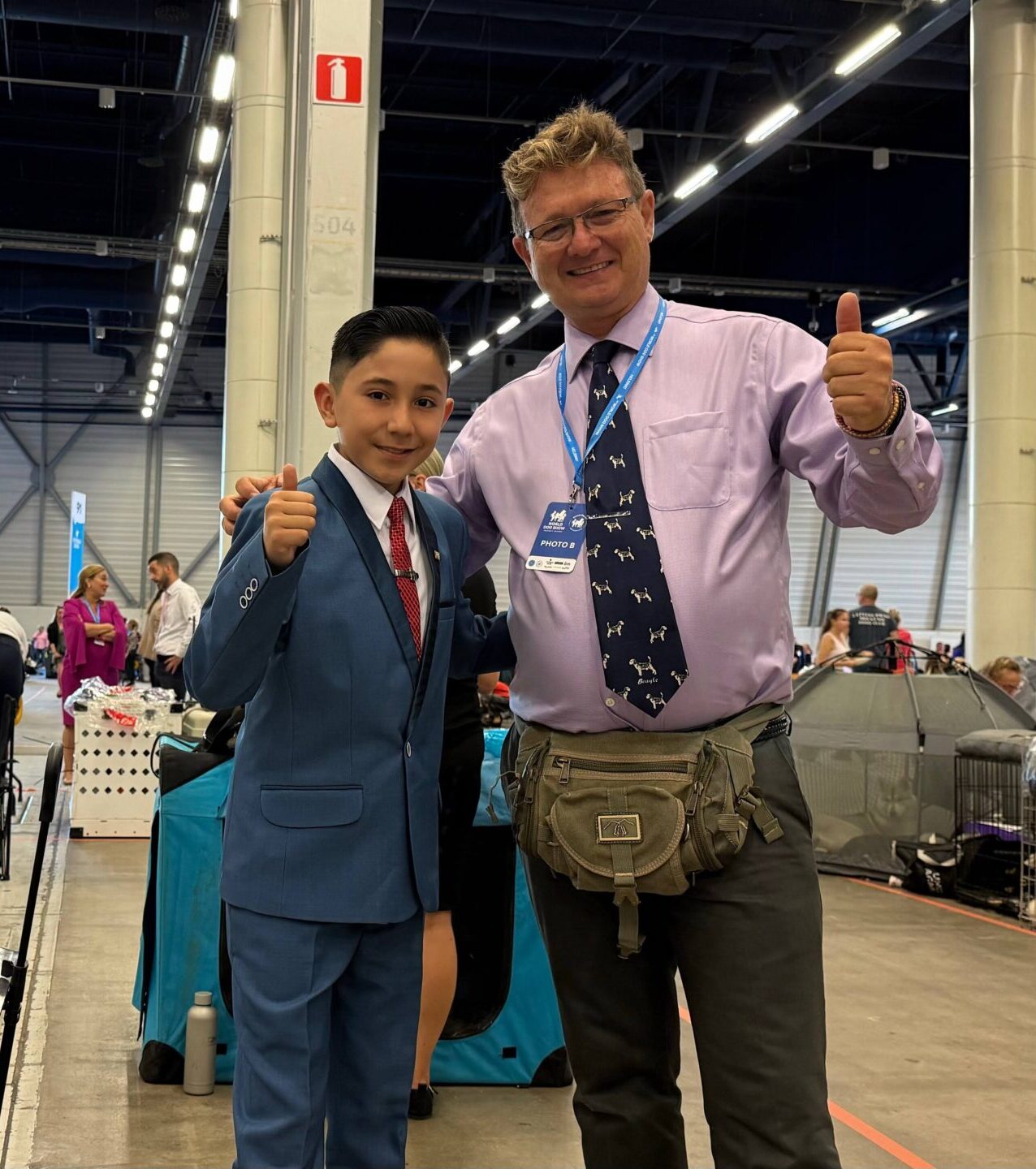
They came from all over the world, and as expected, in addition to the locals, the English and Norwegian neighbors were the most invited. The North American presence was made up of James Donahue and Scott Pfeil, who faced the challenge of finding the best Afghans and Salukis. Also present was the famous Douglas Johnson, who couldn’t hide his passion for his breed. He wore pants with nothing more and nothing less than small Clumber Spaniels printed on them, sensational. He also judged Cockers, Clumbers, Yorkies, Pomeranians, and a few other breeds that surely escape my memory. In short, of course, he did an awesome job as always. On the Latin American side, we were represented by Ilaria Biondi de Ciabatti from Peru and the legendary Adrián Landarte.
But of course, what gave us the most pleasure and filled us with emotion as Mexicans was the participation of my good friend Manuel Queijeiro. There are moments in a man’s life when life looks him in the eye and smiles. This is what happened to Manolo this year. Years of effort studying pedigrees and the breed itself were reflected in this invitation. I could spend many lines writing about some passages where our paths crossed since we met in 1990, memories of his Goldens, some names of his first Labradors, trips, conversations, and much more. That’s why, ever since I heard the news in Zagreb about his inclusion on this panel, I was so pleased. Because he’s one of us, seeing him analyze dog by dog and walk the line in these categories made up of good dogs of his favorite breed, in the presence of his entire family, it was very touching.
Manolo: You just received an Academy Award; we’ve seen your best film. Yours is a triumph of passion and faith, of perseverance and commitment to your breed. I’m happy to say this to you upfront; I’m very happy to call myself your friend.
The Stands.
Those who know me know that the commercial side of these events isn’t my thing. A line of women’s clothing caught my attention, specifically designed for dog shows. It was made of hair-repellent fabrics with plenty of stretch and plastic pockets to resist the presence of bait. Rechargeable hair dryers made an appearance; they weren’t expensive, and I saw them being used around, drying and straightening more than one topknot.
But the cultural aspect and promotion of clubs and breeds is what I really want to highlight. The Polish Club had its stand, where they were giving away a book with a detailed history and illustrated standard for their eleven native breeds to anyone who identified themselves as a judge. It’s sensational. It’s true that these are breeds that we rarely see and judge in our country, but the reader should know that my overwhelming obsession with collecting dog books, even if they aren’t the most practical, is something I can’t avoid. I only bought one anatomy book at the “Our Dogs” stand and resisted buying any at a stand selling old books, all in Finnish and a few other languages unfamiliar to me.
The local Kennel Club was very successful in publishing a full-color, large-format magazine that basically showcased all their breeding-related technological advances. One article that talked about a program they have to eliminate problems in some breeds by crossing them with each other. Yes, you read that right! Interracial crossbreeding with a purpose. I haven’t had the time to read this yet, as it deserves my full attention. The idea really blew my mind.
Conclusions.
Without a doubt, in many ways, the best World Dog Show I’ve ever been to. The financial resources were more than evident, allowing for production that bordered on the unreal. An event where timing was perfectly managed in first-world facilities. if you are interesting in the results click here.
And I’ll close this article with a summary of the brief conversation I had with a waitress on Monday morning while I was drinking coffee in downtown Helsinki. I had already read somewhere that Finnish culture and idiosyncrasy aren’t adept at what’s known as “small talk.” This term refers to all those conversations we Latinos use to fill in the gaps between one important conversation and another, in other words, all the talk we do that’s not important. I didn’t even know the name of the friendly girl. I asked her what she thought and what she could tell me about this issue, and without hesitation she replied: “The thing is, we Finns enjoy silence.”
Long live the sport of purebred dog breeding, long live the World Championships and Finland. “The best is yet to come.”