
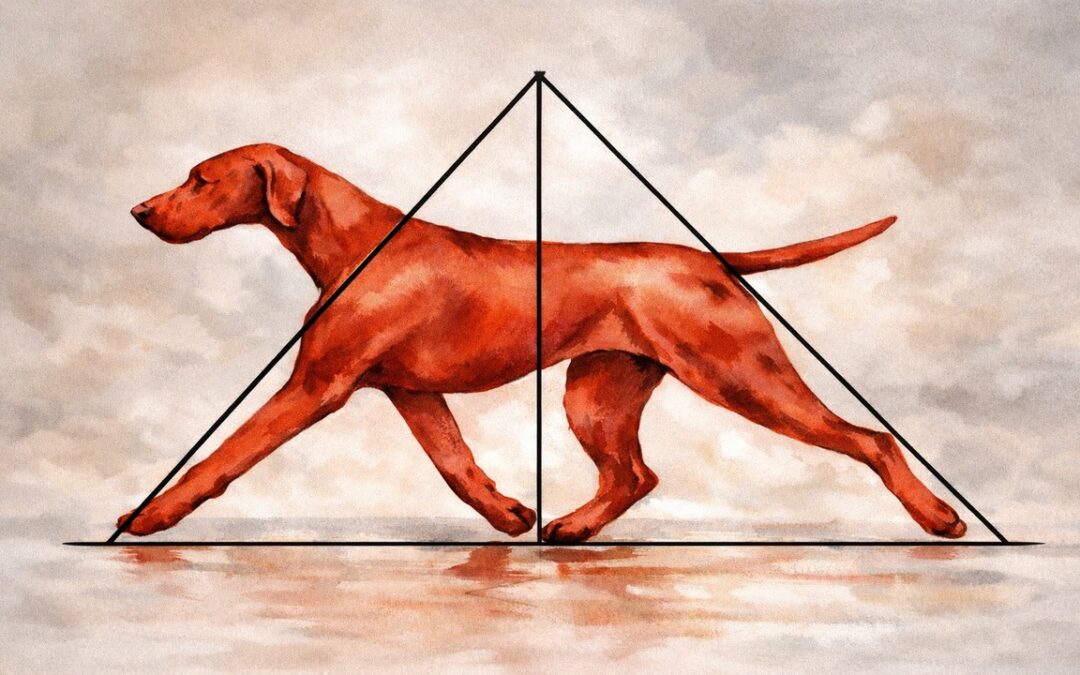
Understanding show dog movement is fundamental for any breeder, exhibitor, or handler who aspires to present a dog correctly in the ring and achieve consistent success. is very importan to keep on mind that a well-prepared dog must also be mentally fresh before entering the ring. Movement is not merely an aesthetic detail; it is the visible manifestation of structure, function, and temperament. Good movement equals good structure. This principle is absolute.
In conformation evaluation, judges do not reward animation alone. They reward efficiency, balance, and structural correctness expressed through motion. The way a dog moves reveals whether its construction truly supports its intended purpose.
Form Follows Function: The Structural Design of Breeds
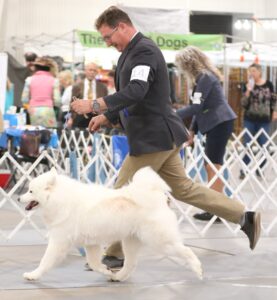
Dog breeds did not arise randomly. Each developed in response to specific human needs such as hunting, herding, guarding, tracking, or vermin control. Genetic selection molded each breed into a structural design that allows it to perform its function efficiently.
A dog designed to work long hours behind livestock cannot share the same structure as a dog bred to dig into burrows or confront quarry underground. Structure always follows function. Therefore, movement becomes the ultimate proof of structural integrity.
Biodynamics: The Science Behind Movement
Biodynamics is the science that studies movement in living beings. In dogs the biomechanical system composed of bones, muscles, ligaments, and tendons acting as coordinated levers. Although this subject could fill an entire book, the objective here is to simplify the principles so they can be applied practically within the show ring.
Each breed possesses particular movement characteristics. Judges evaluate these according to the breed standard. Handlers and exhibitors must therefore understand breed-specific movement as deeply as they understand head type, topline, or proportions.
The Dog as a Biomechanical System
The dog is a living machine whose motion depends on three primary factors: skeletal structure, muscular system, and temperament. These three components determine efficiency, balance, and expression in motion.
Power originates primarily in the hindquarters, especially in the hip joint, the strongest joint complex in the body. Energy generated in the rear is transmitted through the spine and topline, while the forequarters absorb impact and provide extension. This transmission of energy is fundamental to understanding reach and drive.
Types of Gait in the Dog
Dogs move in three primary gaits: walk, trot, and gallop. For conformation purposes, the trot is the most important. It allows the judge to clearly assess structure, balance, and efficiency.
The Trot and the Principle of Efficiency
The trot is a two-beat diagonal gait. A front limb and the opposite rear limb move together, followed by the alternate diagonal pair. There is often a brief moment when all four feet leave the ground, sometimes referred to as suspension. In certain breeds such as the German Shepherd Dog or the Afghan Hound, this suspension may be more evident.
Efficiency is the key concept in gait analysis. A well-constructed dog performs its function with minimal wasted energy, allowing longer duration of work with less fatigue. Poor structure forces compensation and results in inefficiency.
Didactic Classification of Breeds According to Movement
For educational purposes, breeds can be divided into two major groups.
Group One: Classic or Simple Movement
These breeds do not require special rolling, pacing, or unique motion patterns. Most working and hunting breeds belong to this category. Their movement should demonstrate balanced angulation, ground-covering reach, and strong drive without exaggeration.
Group Two: Breeds with Specific Movement Characteristics
Some breeds possess unique movement requirements defined by their standards, such as the Fila Brasileiro or the English Bulldog. These must be evaluated according to their distinct functional and historical context.
This article focuses primarily on the first group to establish universal principles of correct show dog movement.
Evaluation in the Ring: Two Essential Perspectives
Judges evaluate movement from two principal viewpoints: side gait and the down-and-back pattern (coming and going). Both perspectives reveal different structural truths.
Side Gait: Balance, Reach, and Drive
The most important element in side gait is balance, the correct relationship between front and rear angulation. Angulation refers to the degree of opening between the long axes of two bones forming a joint.
Front Angulation and Reach
In many structurally classic breeds, the scapulohumeral angle ideally approaches 90 degrees. This angulation determines reach, the forward extension of the forelimb. Proper reach allows the dog to utilize power generated in the rear efficiently.
Rear Angulation and Drive
Rear angulation, especially through the hip and femur joint, produces drive, the propulsion that moves the dog forward. In a balanced specimen, front and rear angulation harmonize.
Reach and Drive: Structural Harmony in Motion
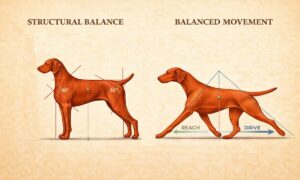
When front and rear assemblies correspond proportionally, the dog maintains its center of gravity correctly and moves with fluidity, rhythm, and efficiency. This is the classic picture of reach and drive that judges seek.
Balanced and Unbalanced Dogs
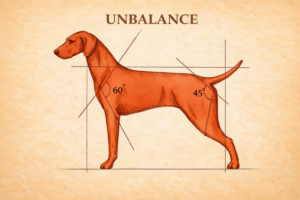
In unbalanced dogs, front and rear angulation do not correspond. To compensate, the dog shifts its center of balance forward, often lowering the head and projecting it outward. While such dogs may appear flashy, their movement lacks true efficiency.
Conversely, some dogs may possess limited angulation both front and rear but remain proportionate. Though lacking extension, they often move more harmoniously than structurally mismatched specimens.
Straightness and Limb Alignment
Correct limb alignment is essential. From the front, forelegs should appear straight and parallel. From behind, hocks should also track parallel. Deviations such as cow hocks, crossing, paddling, or weaving reduce efficiency and are penalized in evaluation. All this problems can be even detect by the judge even when the dog is stacking.
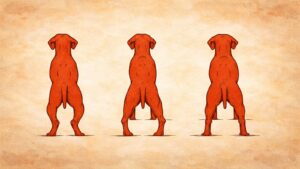
Coming and Going: Single Tracking
As speed increases, many breeds converge toward a single track, meaning the limbs move closer to the center line. Some breeds remain parallel due to front width or structure. Others display front width greater than rear width, which may be breed-typical.
Crabbing (Sidewinding Movement)
Crabbing occurs when the dog moves with its body angled rather than straight. This may result from structural imbalance, incorrect proportions, or insufficient training. An experienced handler can demonstrate whether the issue is structural or learned behavior by presenting the dog properly in both directions.
Muscle, Conditioning, and Genetic Selection
While skeletal structure cannot be altered, muscular conditioning can be improved through appropriate exercise and nutrition. Enhanced muscle tone supports more efficient biodynamics. Structural faults, however, can only be corrected through selective breeding over generations.
Temperament: The Final Determinant
Even the best structure is meaningless if the dog lacks attitude or willingness to move. The show dog must be confident, animated, and mentally sound. Temperament acts as the final catalyst that activates structural potential.
In the show ring, there is only one opportunity to create a first impression. Structure, efficiency, conditioning, and temperament must work together seamlessly.
Conclusion
Analyzing show dog movement requires understanding biodynamics, structural balance, efficiency, and presentation. Mastery of these principles allows breeders, handlers, and judges to evaluate dogs beyond superficial appearance. A deeper and more illustrated exploration of these concepts will be presented in the forthcoming book. Movement is important, but also keep on mind that correct stacking enhances the visual expression of movement.
The best is yet to come.