

Judging Beagles at the World Dog Show Madrid 2022: A Judge’s Perspective
Published originally in October 2022 in the printed magazine Show Beagles Worldwide. Reproduced here with permission.
Introduction
Even long before I began judging, I always disliked seeing people with poor criteria standing ringside, watching a judge handle a class of one or two dogs, and immediately passing judgment on his abilities as if they had known him all their lives. As is often the case, those comments are usually negative, since negative people abound in our sport.
It is always important to remember think and act positively.
As I mentioned in a previous interview kindly conducted by our dear editor, Alice Cancíková, judging dogs is like playing chess. Judging is a complex process far more complex than it appears on the surface. The fact that an experienced judge can do it with apparent ease does not mean the task itself is easy.
Judging Is Like Playing Chess
In a class of five or six dogs, the judge must constantly feed the brain with information about each dog. And when I say “feed,” I do not mean simply storing ideas.
Each piece of information must be analyzed and, above all, evaluated according to the importance it holds for that specific breed. For example, eye color in a lemon or blue Beagle would be highly incorrect in a tricolor, yet everything must still be processed as part of the dog’s overall picture.
This takes time, yes, but it must also be done smoothly, especially when you have 180 dogs to judge in a single day.
The World Dog Show 2022 in Madrid
During the recent World Dog Show 2022, each breed had the opportunity to compete three times. Due to my commitments to the dogs I was showing, I was only able to watch the Beagle judging twice, and those two judging experiences could not have been more different.
The CAC Specialty: Precision and Respect in Judging
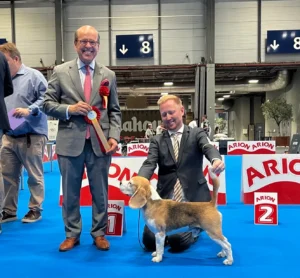
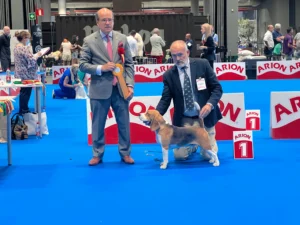
I was already aware of the excellent reputation of the Portuguese judge José Homem de Mello Colaço, who judged the Beagles on Friday at the CAC Specialty.
He did not disappoint me. He earned all my respect and admiration. His judging pattern was so systematic that it allowed him to focus precisely on observing each dog structure closely. Without exaggeration, he dedicated the same amount of time to every exhibitor, which was refreshing to witnesses and demonstrated true respect for those presenting their dogs.
One detail caught my attention, something I had never seen before. When examining dogs on the table, he walked completely around it and evaluated the dog from the right side as well, meaning the handler’s side. It was innovative, clearly his personal style, and it inconvenient to no one.
He took the time needed to decide, never more than necessary, always confident and never hesitant.
Bravo, Mr. de Mello. You played the chess match masterfully, making the right move every time.
About the Beagles
Overall, the quality was quite good. I saw well-proportioned dogs and some frankly heavy-headed ones. The American influence was noticeable, though the overall type still has room for improvement.
Down-and-back movement was generally good, something that is not difficult to find in Beagles anywhere but fronts angulations could certainly be better.
I noticed some black saddles that were not natural, though the work was well executed. Knowing how difficult such tasks can be, I respect the effort. I also expected to see much taller dogs, but, pleasantly, that was not the case.
Madrid Was a Lot of Madrid
Leaving Beagles aside, there is still much to say.
This World Dog Show had extraordinary merits of its own. It was a survivor, a show that overcame the biggest health crisis of the century, several cancellations, and still rose magnificently with nearly 17,000 entries.
The IFEMA venue was perfectly suited for an event of this scale. Rings were excellent in size, spacing allowed exhibitors to work comfortably, and the ability to drive directly to each of the four halls for unloading was a major advantage.
Punctuality was generally good, though it could have been better at times.
Main Ring Production and Organization
The production for the groups and main ring was outstanding. Each judging was displayed on screen with the judge’s name and class. Lighting and music were tasteful present but never overpowering.
The two masters of ceremonies, María José Haro in Spanish and Linda Voláriková in English, did a magnificent job narrating each moment.
Beagles did not stand out in the main ring. Both groups were won by Basset Hounds one from Mexico and one from Italy both displaying excellent movement and exceptional temperaments that filled the ring.
The protocol ceremonies were refreshingly brief. The flag handover to the Brazilian delegation included short but meaningful speeches. Special mention goes to RSCE President José Miguel Doval, whose eloquence in both Spanish and English was impressive.
A Memorable Closing Ceremony
The closing ceremony was beautifully executed. As the saying goes, simplicity is the ultimate sophistication. The fusion of opera and Spanish popular music was sublime.
Accompanied by piano, Rafael Malo Alcrudo who also selected Best in Show delivered a striking performance, entering the ring in a tuxedo colored like the Spanish flag, undeniably stealing the night. The ten BIS contenders were all of outstanding quality.
A Personal Note
From the bottom of my heart, Madrid was a fantastic experience. Thanks to Alice’s support, I received my first press badge. As many of you know, my career as a canine communicator is just beginning.
Seeing the perspectives of photojournalists from around the world was fascinating. I returned home with countless new friends and many hours of footage to edit for my YouTube channel a remarkable learning journey.
I will close by saying it once more:
Madrid was a lot of Madrid.
The best is yet to come.